
China's 300 Cities on the Path of Water-Climate Coordination: Exploring the Possibility of Decoupling Greenhouse Gas Emissions from Wastewater Treatment and Water Resource Pressure by 2030
Urban wastewater treatment and recycling facilities are core supports for ensuring water sustainability. However, when planning such facilities, there has long been a lack of clear technical and policy pathways for achieving water–climate coordination that both "alleviates water resource pressure" and "controls greenhouse gas (GHG) emissions."
To address this critical scientific issue, a team led by Professor Chen Shaoqing from Sun Yat-sen University, in collaboration with Beibei Liu’s team from Nanjing University, the Georgia Institute of Technology (USA), and other institutions, conducted a study focusing on more than 300 cities in China. The research systematically analyzed the relationship between urban water resource pressure and life-cycle GHG emissions during the expansion of wastewater treatment facilities, and proposed feasible options for decoupling the two by 2030.
The findings were published in Nature Water (2023, Volume 1, pages 534–546, DOI: 10.1038/s44221-023-00087-4) under the title Decoupling wastewater-related greenhouse gas emissions and water stress alleviation across 300 cities in China is challenging yet plausible by 2030, providing an important China-based reference for global urban water–climate coordinated governance.
The research team first conducted a retrospective analysis of wastewater treatment systems in 300 Chinese cities from 2006 to 2015, revealing a "coordinated growth" pattern between water resource pressure alleviation and GHG emissions. Although the expansion of urban wastewater treatment capacity and the promotion of recycled water reuse increased the average degree of water pressure alleviation by nearly threefold—significantly improving urban water security—it was accompanied by a 176% increase in total life-cycle GHG emissions from wastewater treatment.This situation—where "relief effects coexist with environmental costs"—reflects the limitations of traditional wastewater treatment models in water–climate coordination: while facility expansion addresses water scarcity, it simultaneously intensifies climate pressure due to carbon emissions from energy consumption, sludge disposal, and other processes. The two have not yet achieved a "decoupled" relationship (where water resource pressure alleviation no longer depends on the simultaneous growth of GHG emissions).
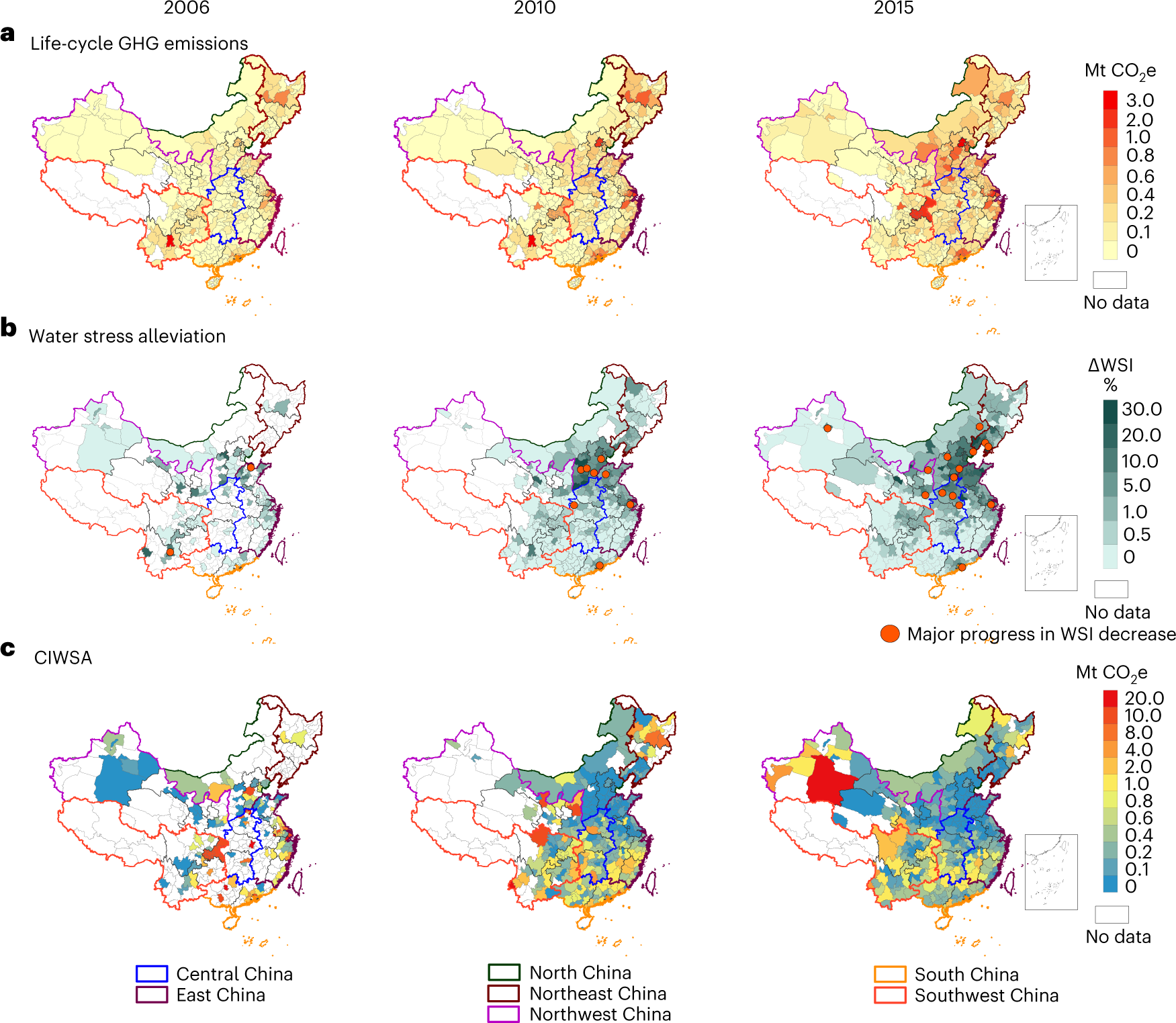
To overcome this limitation, the research team has proposed a core pathway of "integrating existing low-carbon technologies," which covers three key areas: optimization of sewage treatment processes, harmless disposal and resource utilization of sludge, and upgrading of reclaimed water reuse systems. By constructing simulation models for different scenarios, the team has made the following projections: Under the optimized scenario by 2030, through the widespread application of these mature low-carbon technologies, China is expected to reduce greenhouse gas (GHG) emissions related to sewage treatment by 27% at the national level. More notably, cities in eastern and northern China – regions typically facing greater water resource pressure and having a higher density of sewage treatment facilities – can achieve "a GHG emission reduction of over 40% corresponding to the alleviation of per unit water resource pressure." This means these cities can obtain more significant water security guarantees at a lower climatic cost, truly realizing a deep decoupling between the alleviation of water resource pressure and GHG emissions.

From a methodological perspective, the core value of this study lies in the establishment of an "urban sewage treatment water-climate nexus analysis framework from a life-cycle perspective." Unlike traditional studies that only focus on emissions during the operation phase of sewage treatment plants, the research team extended the scope of greenhouse gas (GHG) accounting to the entire life cycle, covering links such as facility construction, energy and chemical consumption, sludge transportation and disposal, and reclaimed water distribution. Meanwhile, by incorporating the spatial heterogeneity of 300 cities (including water resource endowments, economic development levels, and the foundation of existing facilities), the team quantified the differences in decoupling potential across various regions. This approach of "full life cycle + large-sample spatial analysis" not only ensures the scientific validity and comprehensiveness of the research conclusions but also provides an accurate basis for formulating differentiated water-climate synergy policies in different regions. For example, northern cities facing extreme water shortages can prioritize enhancing low-carbon distribution technologies for reclaimed water reuse, while eastern cities with large sludge output can focus on advancing resource utilization technologies such as sludge anaerobic digestion for biogas production.
The academic and practical significance of this study is reflected in three dimensions:
Theoretical dimension: It deepens the understanding of the "water-climate nexus," reveals the transformation conditions for the relationship between water and climate in urban sewage treatment systems from "synergistic growth" to "deep decoupling," and fills the research gap in this field under large-scale urban samples.
Technological dimension: It confirms that the integrated application of existing low-carbon technologies is not a "single-point breakthrough" but a "systematic synergy." Only through technological linkage among sewage treatment, sludge disposal, and water reuse links can the decoupling effect be maximized.
Policy dimension: It provides a concrete path for the coordinated advancement of China's "dual carbon" goals (carbon peaking and carbon neutrality) and "water resource security guarantees." In particular, the differentiated recommendations for different regions can directly serve as scientific support for the planning of urban sewage treatment facilities during the "14th Five-Year Plan" period and even the "15th Five-Year Plan" period.
Globally, the practical sample of 300 Chinese cities holds significant reference value. Currently, many developing countries are confronted with the dual challenges of "water scarcity" and "climate pressure" in the process of urbanization. The idea proposed in this study – "achieving decoupling through the integration of existing technologies" – avoids reliance on "immature new technologies" and thus boasts greater operability and promotion value. As the research team emphasizes, achieving water-climate synergy is not an "impossible challenge" but a goal within reach through scientific planning and technological optimization. This conclusion has injected important confidence into the sustainable development of cities worldwide.
